



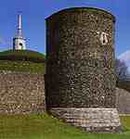
The Roman Museum houses an in situ mosaic pavement dating from around 300 CE. Surviving structures from the Roman times include Queningate, a blocked gate in the city walls, and the Dane John Mound, once part of a Roman cemetery. The Dane John Gardens were built beside the mound in the 18th century, and a memorial was placed on the mound's summit. A windmill was on the mound between 1731 and 1839.
The ruins of the Norman Canterbury Castle and St Augustine's Abbey are both open to the public. The medieval St Margaret's Church now houses the "The Canterbury Tales", in which life-sized character models reconstruct Geoffrey Chaucer's stories. The Westgate is now a museum relating to its history as a jail. The medieval church of St Alphege became redundant in 1982 but had a new lease of life as the Canterbury Urban Studies Centre, later renamed the Canterbury Environment Centre; the building is used by the King's School.
The Old Synagogue at Canterbury, now the King's School Music Room, is one of only two Egyptian Revival synagogues still standing. The city centre contains many timber-framed 16th- and 17th -century houses, including the "Old Weaver's House" used by the Huguenots. St Martin's Mill is the only surviving mill out of the six known to have stood in Canterbury. It was built in 1817 and worked until 1890; it is now a house conversion.
Source & More Information: Canterbury, http://en.wikipedia.org/w/index.php?title=Canterbury&oldid=452227503